 Subscribe to one of my feeds:
- Update 2023-09-10: Diagram of our setup, comments on yearly production estimation and self-sufficiency.
We've decided to add a decent photovoltaic (PV) setup to our house in the house planning phase.
For example, we've been adding cables from the engineering room to the roof. This is the story about early plans until we've got our PV and experiences and statistics after half a year.
Our main goals were:
- Do something against the climate catastrophe we're going through in the next centuries
- Reduce the energy bill with DIY-power
- Beat the high volatile power prices after Putin's war on the world
- Be a bit more independent from the power grid
- Protect our house from loss of grid power which we expect to happen more and more in future
Please notice that the list doesn't contain something like "earn money" or "have a great return of invest (ROI)". This is important because I planned to invest some money into a house battery. With a decent battery size, there is a poor chance that you get more money back during the life-span of your components than you have invested. This supports our goals with gaining more independence. More on that later.
Feel free to skip some sections if you are just interested in the result and not the journey.
Planning Phase and the Search for a Company
With PV prices going down technology options getting better, we've been looking for information and companies related to PV since probably 2021. With Putin's aggressive war on Ukraine and its results on the European Power Market (prices exploded), we've intensified our project and tried to hire a company to install a PV.
This was also the time when the contract with our power supplier reached its end and the company decided that they won't offer us a follow-up contract at all. With the new power supplier, our monthly charge went up from 117€ to 341€. That means our monthly power bill almost tripled!
Unfortunately, we were not the only ones with this great idea of installing PV. The company that originally installed our electric system when we built the house offered me an initial meeting slot not less than nine months in the future which was not an option for us.
I wrote to ten local companies I could find and only one called back. I went to meet them, presenting my specific situation and thoughts. To my disappointment, they did not want to discuss much of my questions and thoughts. I got the impression that they've got only one type of hardware and sell it as is, without any intent of adapting to specific needs or desires. The price was somewhat OK but I did not feel understood.
So I played with the thought of installing it on my own and finding a company that would approve the result to meet regulative constraints. Spending time learning all that stuff on web pages and online videos made me realize that there is too much experience I'm lacking in order to do this in a way I would find acceptable.
Luckily, we've finally got into contact to a new company which was founded in 2022 that still had capacity left and whose owner was very happy discussing thoughts and ideas with me.
Our Hardware
The decision for specific hardware devices was a proposal from the company we've hired. It's certainly not a minimal solution and I was aware of that. They're specialists for Victron products which allow operation in isolated network when there is no grid or the grid currently not available such as in boats or mountain huts.
Victron power inverters also have the advantage that in case of a switch between grid power and isolated network, there is no period without power down as for example with normal power inverters like the popular Fronius products.
We've got an Energy Storage System that basically consists of:
- three Victron
Multiplus 2 48/5000 power inverters
- connected to the grid, to our house as well as to the battery
- two BYD B-Box LVL 15.4
(15.36 kWh)
- Battery Cell Technology: Lithium Iron Phosphate (cobalt-free)
- Max Continuous Output Current: 250 A
- Peak Output Current: 375 A, 5 s
- Dimensions (H/W/D): 660×650×575 mm
- Operating Voltage: 40-57.6 V
- Round-trip Efficiency: ≥95%
- Victron Cerbo GX
- the "brain" that controls all devices
- 34 PV Modules: Solarmodul 385 Wp JAM60S20-385/MR BLACKFRAME
- Fronius Symo 12.0-3-M power inverter
- 2 MPP-trackers
- converts the DC power from the modules to 230V for the house
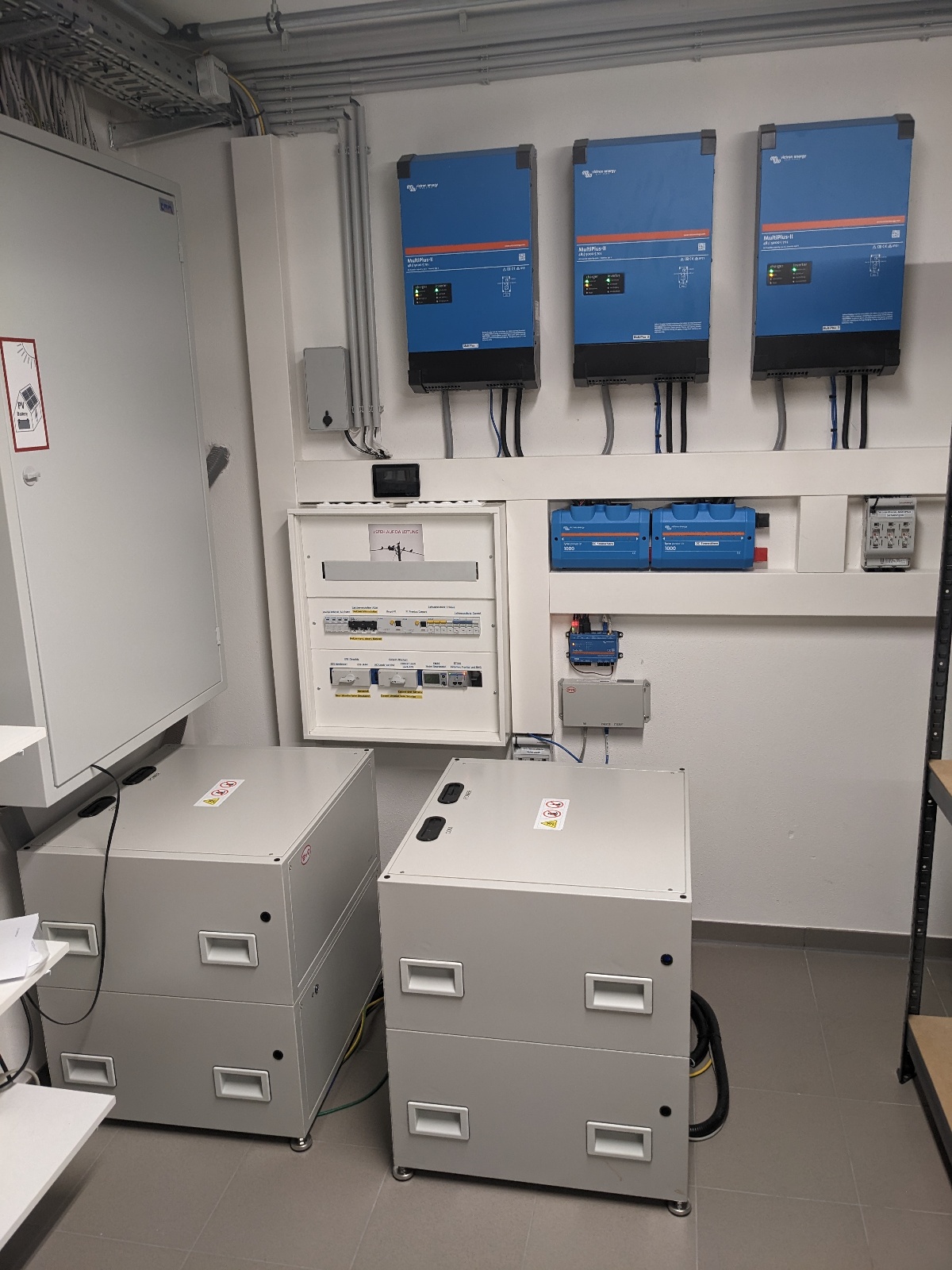
That's probably one of the best PV setups you can currently get for a house.
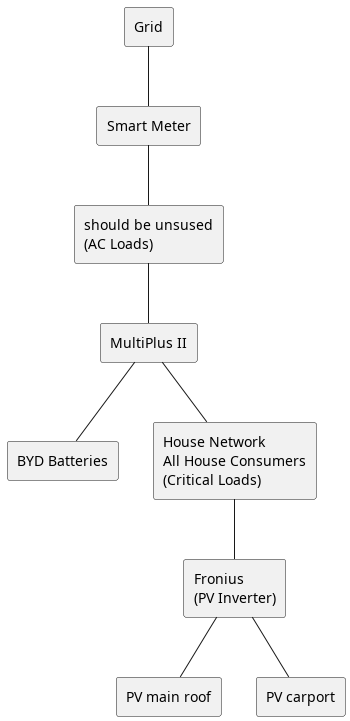
The Victron Multiplus are handling the take-over from and to the grid as well as the basic battery voltage conversion between 230V (home) and 48V (battery).
The Fronius is only connected to the PC modules and the home network. It converts the PC power of the modules to 230V.
Solar Panels
Our PV modules are placed on our flat roof. Although it's oriented almost perfectly to south, it's better to go for east-west orientation with typical 10 degrees assembly. If you'd go for south direction, you'd have to add so much distance between the rows that you actually lose more capacity than gained (German article). With east-west orientation you don't need any space between the modules. This way, you get more power per area.
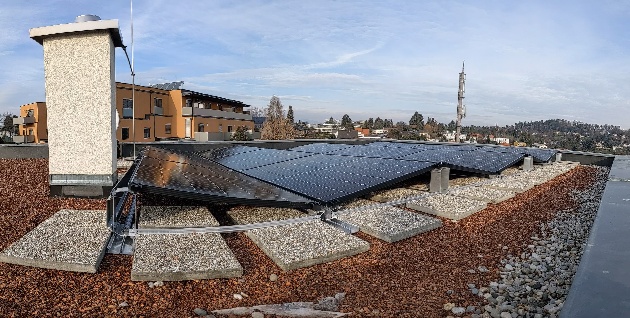
I wanted to maximize the number of solar panels installed. Therefore, my initial plan was to put panels on the roof and panels on the wall facing south. Wall-mounted modules are actually great because when the east-west modules from the roof are not producing much energy in winter because of the low sun, the wall-mounted modules are having their maximum: lower sun and more efficient because of the lower temperature.
Unfortunately, wall-mounting is expensive because of the more complicated mounting equipment. Furthermore, I don't know where the vertical bars of our wooden house are. I would need to drill many holes to find them which is not something you want to do with a well-sealed house.
The company suggested to use the roof of our carport instead of the wall-mounted modules. It's also a flat roof, can deal with the weight but it's placed on the northern side of our house. Therefore, it's in the shade of our house as long as the sun is not very high.
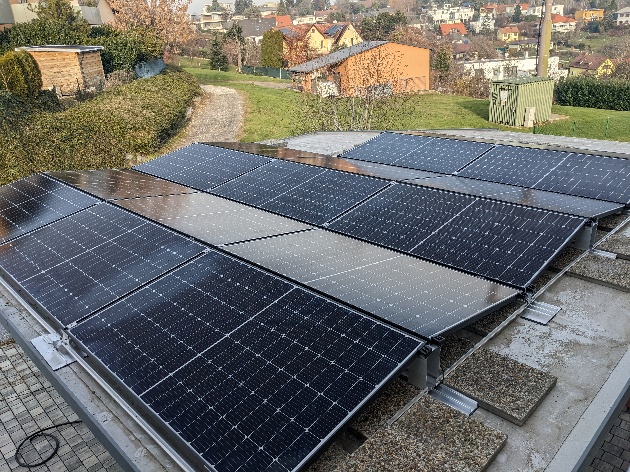
The good thing is that the carport roof is rather large. So it could fit almost the same amount of modules than we've put on the main roof. Better than nothing if you want to maximize for solar power production. We also decided to use the same mounting option as for the main roof: ten degrees east-west with enough weights to make sure they are not moving with strong winds.
The Fronius does come with two MPPTs: one for the east-west modules of the main roof, one for the east-west modules of the carport. This German study showed that you don't have to use an MPPT each for east and west. This would have required four different MPPTs in total. You can use one MPPT for modules looking in both directions without losing too much energy. That's a financial trade-off because MPPTs are not that cheap as well.
Properties of Our Setup
With this concept, we've got a big uninterruptible power supply for our house. We don't realize any power outage since the take-over is managed instantly, we don't need to power down high consumers when the grid is not supporting us and in case the grid is up again, the system re-synchronizes itself with the grid fully automatically.
Of course, that comes with a high price tag we had to pay. However, we get convenience and independence. My carport doesn't have a ROI either.
Opportunities for Home Automation
The Victron Cerbo GX has many options to be integrated into an existing home automation.
Using the Modbus API, Home Assistant is able to connect. See also that page. Be careful, the syntax has changed so there are many outdated instructions on the web. It's rather complicated and comes with a shitload on trial and error to make anything run. Furthermore, I was only able to get a handful of values from the Victron to Home Assistant out of hundreds of values. The large majority of the values just didn't work in Home Assistant and I couldn't find out why yet.
Another downside I had to find out is that there can only be one single Modbus device talking to Home Assistant. So I do have to choose if I want to connect to my Victron system or to my heat pump. This is an issue I haven't resolved yet.
And if this would not be enough bad news already, I haven't been able to figure out how to get values from my heat pump via an expensive device called ISG+ (Internet Serice Gateway) to Home Assistant either: although my configuration doesn't cause any error in the Home Assistant logs, there are no entities showing up in the Home Assistant interface yet.
So bad luck on that front so far.
Fortunately, it's not that urgent for me to connect the Victron or the heat pump to any home automation. It works quite well as is. Even the cloud-based Victron Android App is really good.
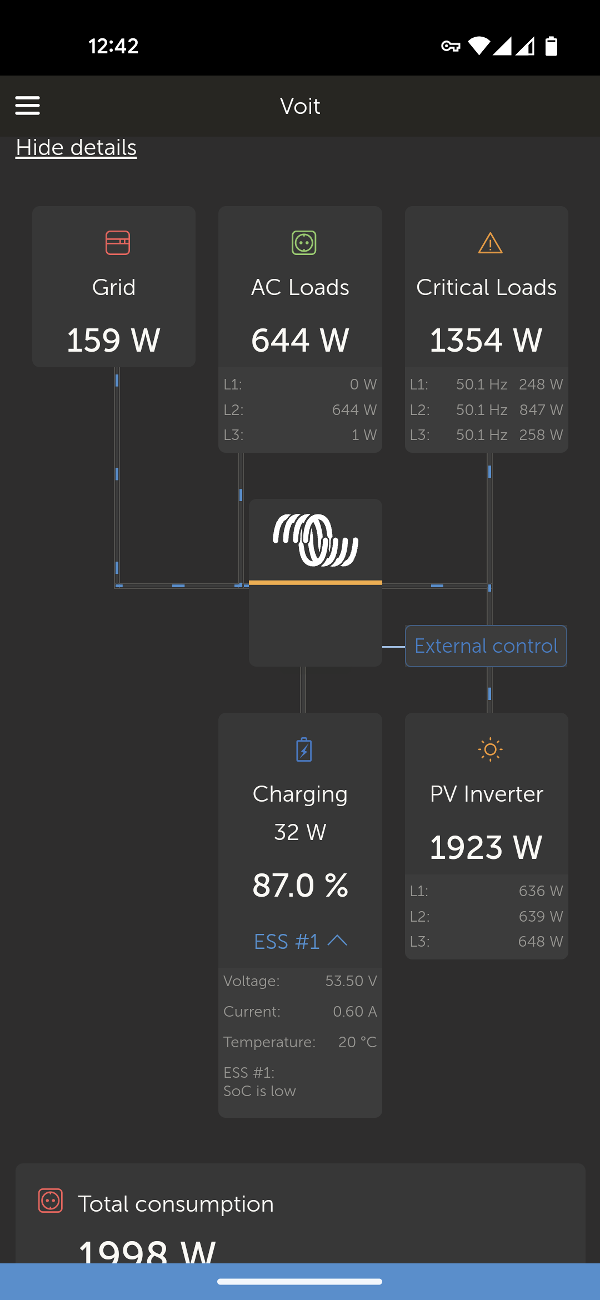
A neat trick I was using was to re-program my heat pump schedule. Previously, the hot water had a constant target temperature of 45 degrees Celsius. When I shower before bedtime, the temperature drops and the heat pump had to invest energy during the night (no sun) to get back to the 45 degrees.
Now, I switched to a different schedule: from 2pm to 5pm, the target temperature is 50 degrees. And it's 40 degree during the rest of the day. This way, the heat pump invests energy at 2pm where there is a high chance of producing energy via PV. After showering before bedtime, the temperature usually drops not more than to 40 degrees which is great because it may wait until 2pm the next day to re-heat again.
In the long run, I want to re-try to connect more than one modbus devices to HA.
Another interesting option on the Victron GX is to use Node-RED. As far as I understood, Victron wants to push this type of customization interface more intense in future. Primary, it's a mouse-based UI but I can think of getting along with it. So far, I just spent a couple of hours with it. It looks promising but I got lost in the manifold of options and was not able to identify the values I was looking for. I need to spend more time with that as well some day.
Effects on Our Power Consumption from the Grid so Far
The ESS was activated on December 21 2022. By coincident, this is also the winter solstice with the shortest day and the lowest theoretical power production of the year.
Since then, we've gained roughly eight months of experience, covering more than the first half of the year. Most values are in kWh.
| Month | →Grid | Grid→ | Solar | Consumption | Grid→Con | Batt→Con | Solar→Con | Sol→Grid | Sol→Batt | max batt %/day | max kWh solar/day | max consumption/day | days <100% batt | |
| ! | month | togrid | fromgrid | solar | consumption | confromgrid | confrombatt | confromsolar | solartogrid | solartobatt | maxbattloadday | maxkwhsolarday | maxconsumptionday | battnotfulldays |
| 2022-12 | 1.6 | 196 | 71 | 230 | 150 | 37 | 44 | 1.1 | 26 | 13 | 9.6 | 25.45 | 7 | |
| 2023-01 | 3.2 | 576 | 193 | 734 | 547 | 63 | 124 | 2.5 | 66 | 19 | 10.6 | 29.59 | 29 | |
| 2023-02 | 9.3 | 293 | 435 | 678 | 274 | 202 | 202 | 8.1 | 224 | 39 | 20.4 | 35.68 | 27 | |
| 2023-03 | 8.0 | 82 | 818 | 631 | 75 | 282 | 274 | 185 | 360 | 46 | 40.9 | 24.24 | 8 | |
| 2023-04 | 491 | 35 | 1096 | 575 | 32 | 251 | 292 | 489 | 316 | 51 | 60.9 | 25.72 | 7 | |
| 2023-05 | 764 | 32 | 1363 | 565 | 29 | 214 | 321 | 761 | 280 | 66 | 76.51 | 34.73 | 5 | |
| 2023-06 | 1073 | 27 | 1664 | 550 | 25 | 183 | 343 | 1071 | 250 | 62 | 79.26 | 34.04 | 2 | |
| 2023-07 | 945 | 29.7 | 1667 | 684 | 29.7 | 250 | 407 | 943 | 317 | 44 | 76.1 | 32.48 | 2 | |
| 2023-08 | 626 | 36.8 | 1311 | 649 | 33.6 | 273 | 342 | 623 | 346 | 55 | 62.2 | 33.74 | 8 |
Some derived analysis numbers:
| Month | Grid→Cons % | Solar→Cons % | Batt→Cons % | Sol/Batt→Cons % | Sol/day | Con/day | Solar/Cons % | %days batt<100% | Days/month | |
| ! | month | numdays | ||||||||
| 2022-12 | 65.2 | 19.1 | 16.1 | 35.2 | 7.9 | 25.6 | 31 | 78 | 9 | |
| 2023-01 | 74.5 | 16.9 | 8.6 | 25.5 | 6.2 | 23.7 | 26 | 94 | 31 | |
| 2023-02 | 40.4 | 29.8 | 29.8 | 59.6 | 15.5 | 24.2 | 64 | 96 | 28 | |
| 2023-03 | 11.9 | 43.4 | 44.7 | 88.1 | 26.4 | 20.4 | 130 | 26 | 31 | |
| 2023-04 | 5.6 | 50.8 | 43.7 | 94.5 | 36.5 | 19.2 | 191 | 23 | 30 | |
| 2023-05 | 5.1 | 56.8 | 37.9 | 94.7 | 44.0 | 18.2 | 241 | 16 | 31 | |
| 2023-06 | 4.5 | 62.4 | 33.3 | 95.7 | 55.5 | 18.3 | 303 | 7 | 30 | |
| 2023-07 | 4.3 | 59.5 | 36.5 | 96.0 | 53.8 | 22.1 | 244 | 6 | 31 | |
| 2023-08 | 5.2 | 52.7 | 42.1 | 94.8 | 42.3 | 20.9 | 202 | 26 | 31 |
If you sum up Jannuary to June, you get a total production of 5,569 kWh which is 5.6 Megawatt-hours. To extrapolate the yearly production we can double that value and get 11,138 kWh or over eleven Megawatt-hours. Impressive numbers, I'd say.
As you can see in the tables above that by approximately mid March, we were theoretically independent from the power grid with roughly 95 percent self-sufficiency. The Victrons are getting their operating power from the grid as long as there is power from the grid. This is the small consumption (roughly 30 kWh per month) you're seeing above.
Furthermore, when the grid is up, high energy consumption is also backed up from the grid so that the battery is not stressed too much. Same holds true for high production: not all the energy is guided to the battery. This is capped with some sensible value as long as the grid is up.
Almost 100 percent independence from mid March to probably mid October is much better than I've anticipated. This is really awesome.
It was not until a longer period of bad weather in the early days of August 2023 where the battery reached its configured minimum SOC (state of charge) of 20 percent for the first time after March. This caused some slightly increased amount of power from the grid which we see in the August statistics.
I could discuss ideas on how to dynamically choose minimum SOC settings much more but that'll probably be a future blog article. For now, I'm planning to go up in the darker months up to 80 percent. A higher min SOC reserves more battery capacity in case the grid is lost. A smaller min SOC means more room for self-generated power and consumption during the day. So there is a classic trade-off to be made. According to the lower level of energy created, a higher min SOC is desired in winter in case you want to optimize when the grid is down.
I also realized that our power consumption in summer is very high due to the heat pump that also is doing some cooling (increased Con/day). However, with our floor heating this is ineffective and costs much energy for a small effect. Fortunately, this is also the time with the highest PV production so I don't care that much any more.
Lessons Learned
If you want to optimize financially, don't buy too much solar modules and use a small battery if any at all. No fancy ESS but a normal power inverter. This way, you get a ROI within the life-span of the components.
If you buy a car, you also don't calculate with some financial ROI. You get the benefits from using a car to go from A to B any time and you probably will get a fraction of money back when you sell the car some day. And this is the way you need to think when you buy a battery and a large PV setup these days.
With a fancy (and expensive) ESS you get independence, reliability and stronger supply. No free lunch here.
Maybe the most important lesson here is that with a PV, you're much more energy aware. Not only but also because of the visible power consumption and generation values you're able to observe. It's a good feeling to get some independence - even in setups without a house battery I presume. This is one possible way of contributing to counter-measures of the ongoing climate catastrophe.
Follow the next articles for more details like the 2023 summary.